
Mao and Then
A look at China's Cultural Revolution reveals patterns we can see in today's identity politics and media. Beware of weaponised fellow citizens.

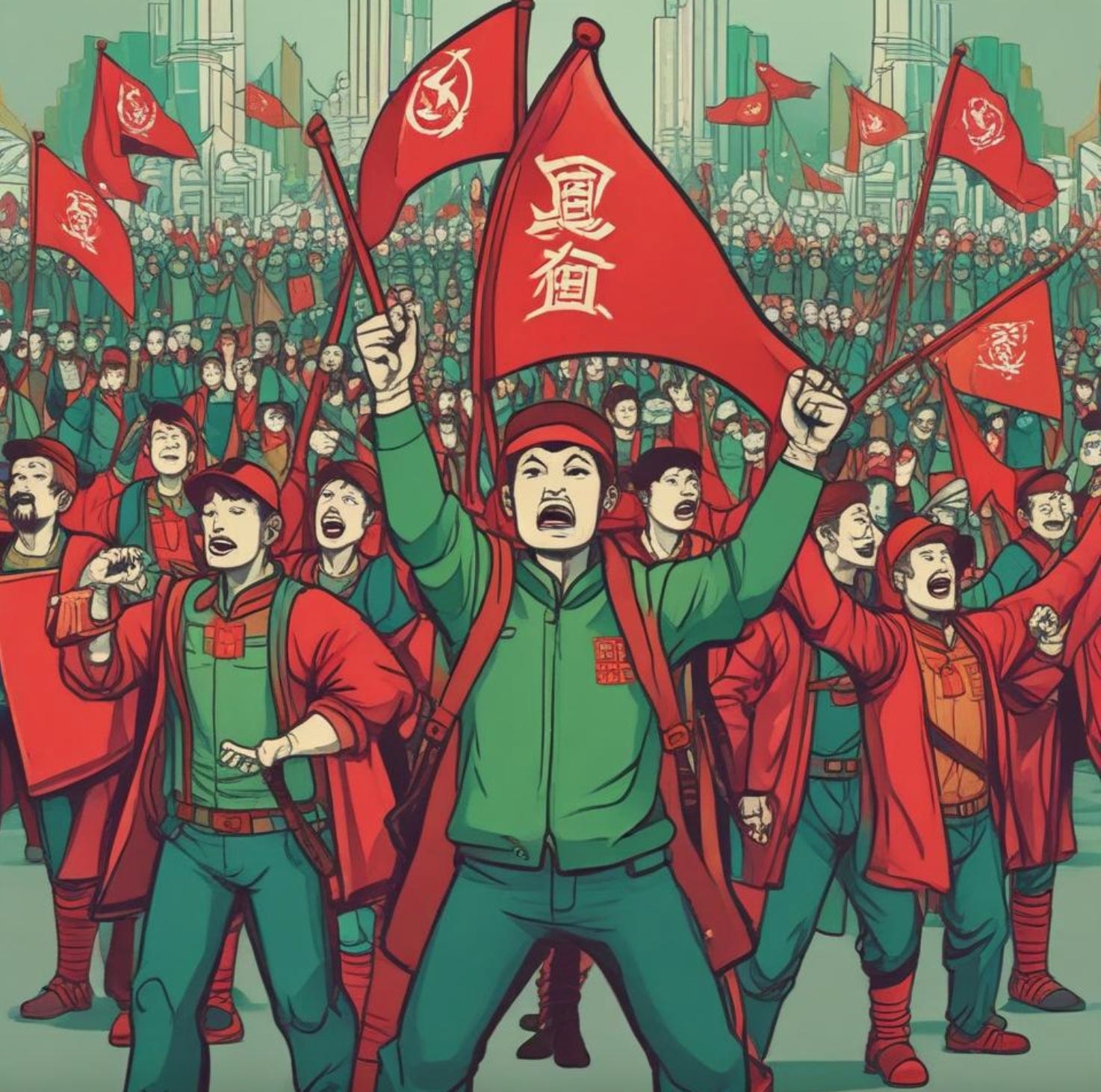
One of the most puzzling questions is how and why ordinary people can be so easily led into violence against their fellow world citizens. This isn’t, of course, a new question. We know from the Milgram experiments of the 1960s that up to 65% of people are prepared to administer a fatal electric shock to a stranger out of obedience to a perceived authority figure wearing a white lab coat. We also know that, while pressing the button they were told would deliver the killer jolt, many of the subjects looked uneasy about it, as was detailed in the report at the time:
"Subjects were uncomfortable administering the shocks, and displayed varying degrees of tension and stress. These signs included sweating, trembling, stuttering, biting their lips, groaning, and digging their fingernails into their skin, and some were even having nervous laughing fits or seizures. 14 of the 40 subjects showed definite signs of nervous laughing or smiling.”
This sort of behaviour is sometimes called “submissive chimp face” - a kind of cringing servility to mask the pain of internal cognitive dissonance. Despite this discomfort, they pressed the kill button anyway, and this is where the problem lies. If enough people can be convinced of something together, an instinctual social primate subroutine takes over and they form a self-referencing feedback loop that can be called a mass psychosis. It doesn’t matter how seemingly crazy or against one’s own nature the belief is.
Once this ‘madness of crowds’ effect has taken hold, very little can be done to convince individuals that their thoughts aren’t their own. It simply has to run its reckless course.
It seems this is a very dangerous flaw running through humans, and something that has been weaponised by tyrants and controllers throughout history. When this human hack is combined with an ideology that justifies violence for some purported ‘greater good’, it can - and usually does - end in a bloodbath. Take, for example, the early Christians, who swept away the ancient classical world in a barbarous assault on Europe in the fourth century AD. An orgy of destruction took place, in which temples were razed to the ground, statues of pagan gods were smashed into rubble, and irreplaceable works of art were put to the torch.
In this case the idealogical programming was a religious one, and Constantine the Great was later so impressed by the terror it inspired that he sought to harvest the energy in a bid to shore up the collapsing Roman Empire. Declaring himself to be a Christian, paganism was soon outlawed and millions were ‘converted’ at the point of a sword. As a means of control, it was a pretty nifty trick.
But powerful as he was as an emperor, he could not have achieved his radical ends without the mass compliance and help from his common subjects. Once a mass psychosis has been implanted in the population at large, it was a relatively easy task of getting the people to turn on one another for failure to adhere to the new code. It became permissible, for example, for people to enter the houses of their neighbours and search them if they were suspected of praying to ‘idols’, and to denounce them. Streets throughout the Roman empire ran red with the blood of those judged not to be complying with the new Christian edict.
From Christianity to communism
Many centuries later, China’s Mao Zedong was able to employ this same human flaw, and by the time he was finished up to 80 million of his fellow citizens lay in early graves. Just like the Roman Empire under Constantine, China was in a parlous state when Mao came onto the scene. The country has been riven by internal strife, with warlords battling it out between regions. Then came the Japanese occupation of China, which saw regular Chinese treated very poorly (to put it mildly, just research the Rape of Nanjing), followed by a Soviet occupation of Manchuria and then a full-on civil war between the Kuomintang nationalists and the ideologically driven Communists. We all know who won.
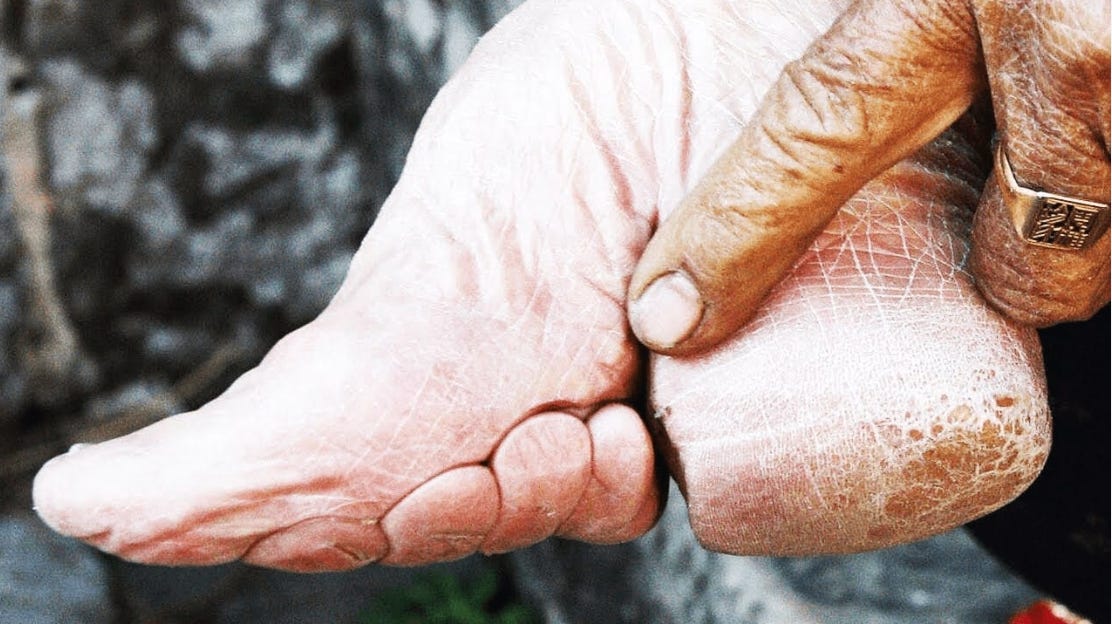
On top of all the wars and invasions, the five-thousand-year-old culture of China had become ossified and moribund. All sorts of exploitation and inequality was justified on the basis of tradition, resulting in a wildly unfair society. Women and girls, for example, were at the absolute bottom rung of the social scale, and were commonly sold by their impoverished parents as concubines. Depending on his status, a man could have several concubines, as well as a wife. Emperors, or ‘Sons of Heaven’, could have several hundred. To make them look more sexually attractive in the eyes of the high-status men, women would have their feet bound from birth. This was considered dainty and faun-like, but it resulted in grotesquely deformed feet that caused agonising life-long pain.
It was against this dismal backdrop that a desperate hunger for change had formed. When Mao’s communists routed the Kuomintang and took power, the jubilation among the common Chinese was off the scale. In short order, the communists abolished many of the old ‘unfair’ traditions, made men and women more equal, confiscated land from farmers, and just generally smashed the old social order. An economy of complete control was rapidly established, with the means of production put under state control, just like Marx had recommended. Food production, under the control of new government cooperatives, was on such a scale that the peasants grew fat. The long-suffering people of China could finally take pride in their country once again.
But the party didn’t last long. Almost immediately, ‘class traitors’ were sought, meaning anyone who might have owned wealth (but lacked Communist Party connections), as well as anyone who had been in or worked with the Kuomintang. An atmosphere of recrimination and fear spread like a miasma, seeping into every aspect of life. Petty scores were settled under the guise of ‘anti communist behaviour’ and inter-personal injustices blossomed.
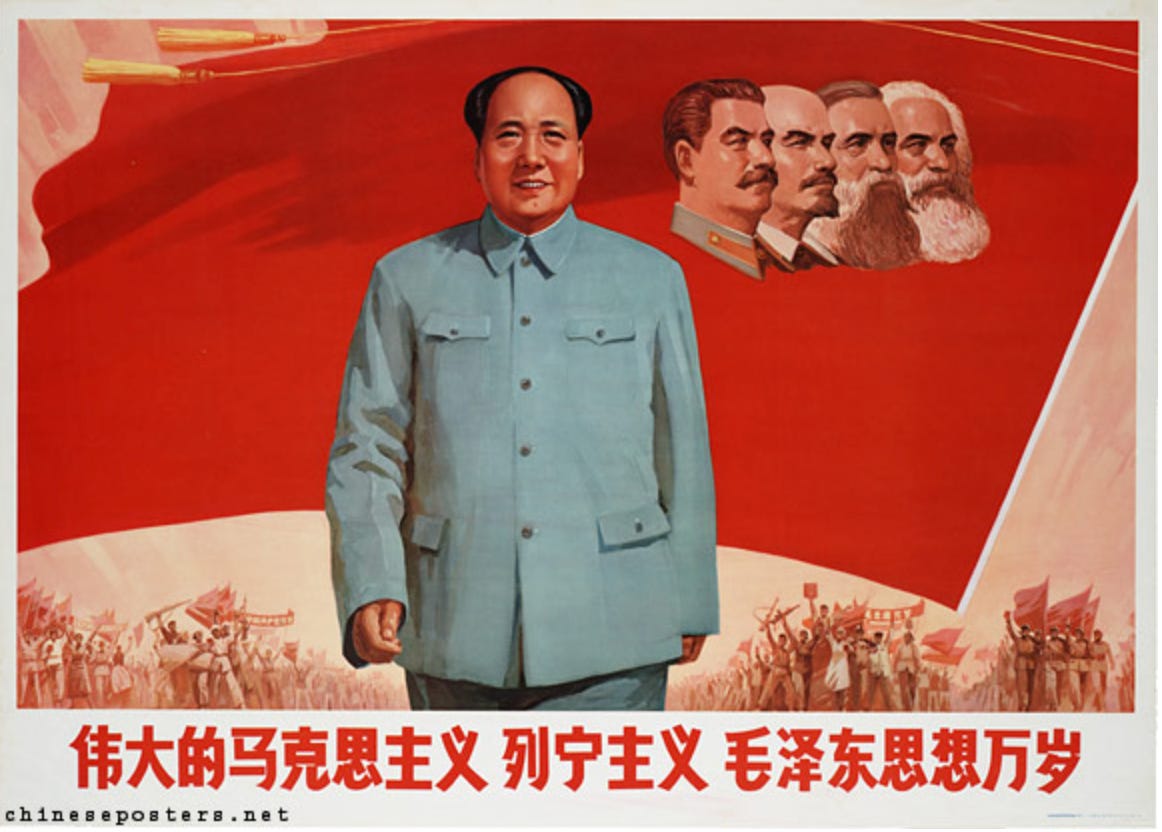
Most of us have at least some idea of how this turned out. Over the course of the next few decades, Mao’s communism hollowed out China and left its culture in ruins and its people in a state of perpetual trauma. In fact, it was only upon Mao’s death in 1976, and thanks to the reforms that followed, that China dared to peek out from under its rock.
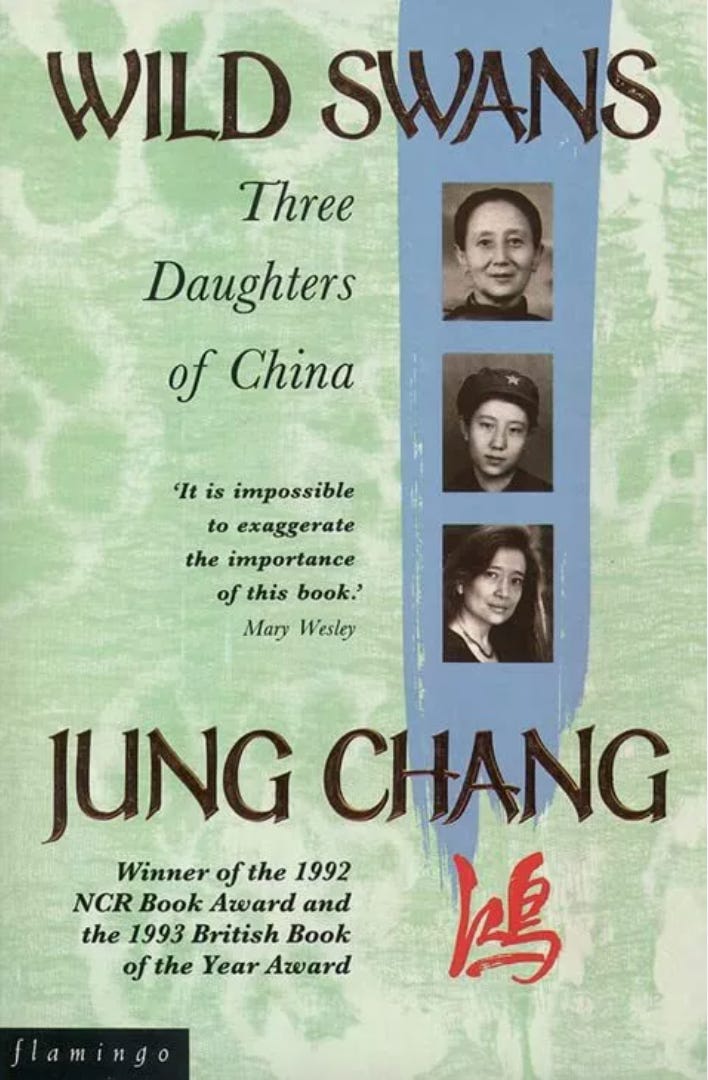
There’s no better book about this period than Jung Chang’s Wild Swans - Three Daughters of China, which lays out in unflinching detail the lives of her grandmother (who had been a foot-bound concubine), her mother and herself. Reading it, if you’re anything like me, you might experience several gasp-out-loud moments as she writes of the sheer brutality and wickedness enacted by everyday people under the spell of Maoism, which was like a religion for most. How Jung Chang and her family survived this era at all is a testament to their remarkable fortitude and resilience.
Mao, as Jung points out towards the end of the book (which she wrote only once she’d escaped to live in London), was really no more than a man with a keen sense of self-preservation. In fact, she calls him a ‘fight promoter’, because that’s where his talents lay. He had learned early on that much of the art of war is getting your enemy to fight among themselves. He had many potential enemies, but like all tyrants, the main one was the people themselves. By brainwashing them into believing that he was a sort of benevolent demigod, and instilling the terror of an unseen ‘enemy’ into them, he maintained the aura of a cult leader. He then splintered Chinese society into numerous groups and created the conditions for them to be in a permanent state of antagonism with one another. This often took the form of one officially-sanctioned group persecuting another.
The Red Guards were one such group. They were comprised of students, some shockingly young, and they went on to commit many of the lesser everyday atrocities over the years. In many cases, membership was compulsory, and Jung Chang counted herself as one of them, albeit a moderate, reluctant member. From Mao’s point of view, students made perfect idealogical stormtroopers. They were lacking in life experience and easily led, they were young, energetic and naturally rebellious, and they could be relied upon to form themselves into ‘Lord of the Flies’ units with the most merciless and resentful among them naturally rising to commander positions.
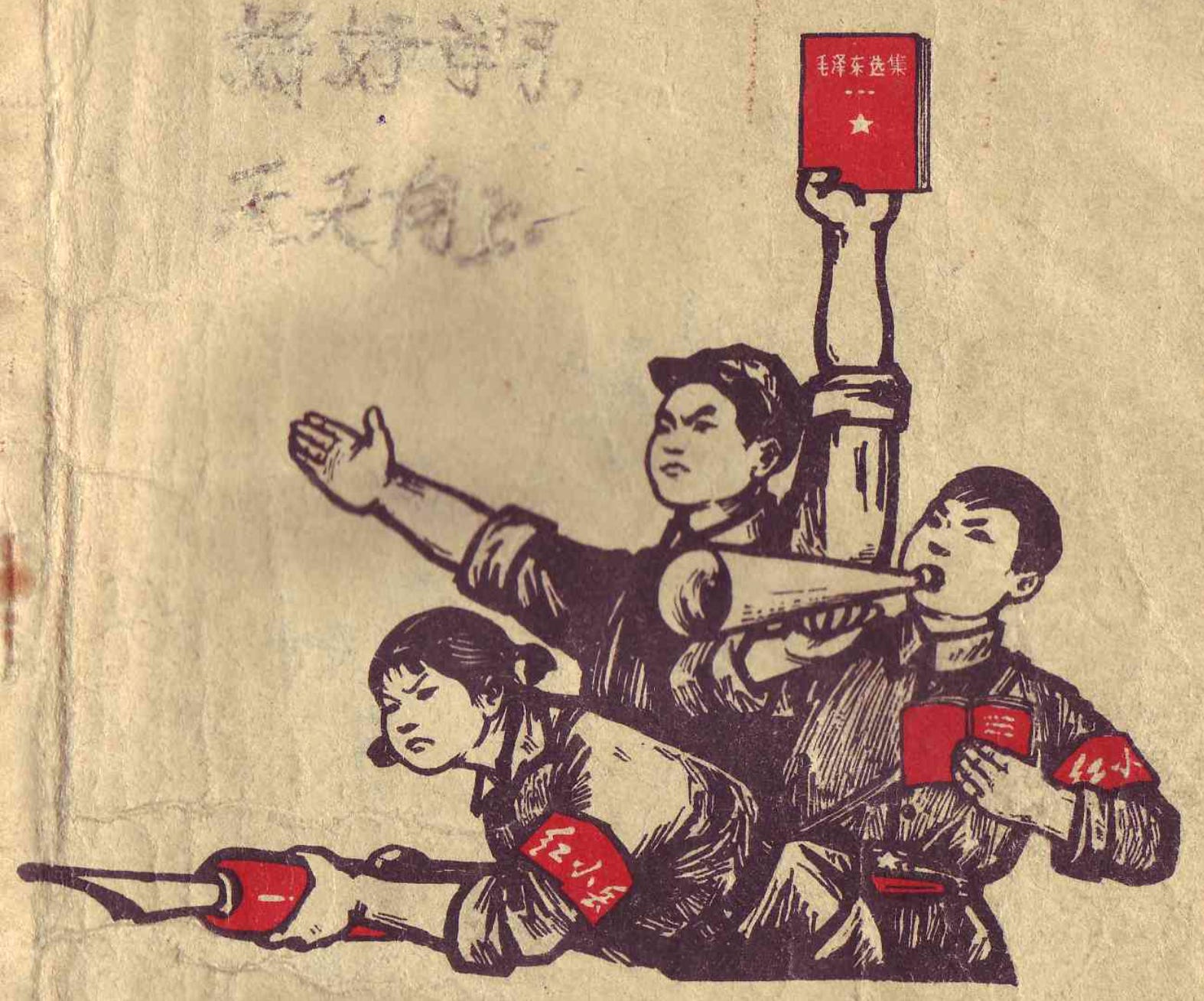
The Red Guards often carried copies of Mao’s Little Red Book, which was a collection of the great man’s revolutionary thoughts, containing such philosophical nuggets as this contemplation of the role of art: “[Our purpose is] to ensure that literature and art fit well into the whole revolutionary machine as a component part, that they operate as powerful weapons for uniting and educating the people and for attacking and destroying the enemy, and that they help the people fight the enemy with one heart and one mind.”
Most of Mao’s quotes revolved around the same themes of violent revolution and intolerance. The words enemy, revolution, attack, destroy, fight and battle recur repeatedly. They were blasted from loudspeakers on every street corner, festooned across posters on city walls, and drilled into the heads of every man, woman and child. The Cultural Revolution saw most books burned and most art destroyed, as well as teachers beaten and locked up, and contact with the outside world (apart from communist Albania, amusingly) was not tolerated. There could be no word except the word of Mao.
One of Mao’s prominent characteristics was paranoia. He was suspicious of other upper-echelon Party officials, just as he was justifiably worried about a real proletarian revolution. Using his skill as a manipulator, from time to time he reversed the roles of the societal subgroups he had created. Thus, almost overnight, loyal party cadres could become political prisoners, state-approved rebels could become outlaws, and the torturer could become the tortured. Fear and confusion among the citizenry kept them divided and weak and ever-alert to fresh dangers.
Another tool used by Mao’s communists was the psychological manipulation technique that we commonly call gaslighting. Gaslighting means forcing your version of reality upon someone, despite what the evidence of their own senses tell them. Thus, according to Jung Chang, peasants were encouraged to boast about incredible - nay impossible - yields, with so-and-so many millions of pounds of potatoes being produced from the tiniest patch of land. Once, she saw a giant truck-sized papier maché pig paraded around town, with everyone agreeing what a miracle that pigs could grow so big now that Mao was their leader. No doubt, anyone who dared point out the emperor’s lack of clothing would soon find themselves converted into food for the (much smaller, real) pigs.
Even when this insanity of pretending food levels were at stratospheric heights led to the Great Chinese Famine of 1959-1961, in which somewhere between 15 and 55 million people starved to death, the gaslighting and pretence continued. Famine, what famine? When Mao finally conceded that there could be some ‘issues’ with food production, he blamed the problems on sparrows pecking grain from the fields. In the subsequent ‘war against sparrows’, every sparrow in China was considered an enemy, and people were encouraged to chase the birds around banging drums (pots and pans, by this point, had been banned because they encouraged individual cooking) until the birds fluttered dead to the ground from exhaustion. While not many sparrows were dispatched in this way, many half-starved people died of exhaustion in the chase. Later, Mao would initiate the ‘war against grass’ for similar reasons. It would be utterly comedic if it wasn’t so tragic.
Mao and then
Where am I going with this? I’d like to suggest the same process of divide and conquer is going on here in the West, and has been going on for quite some time. In case you hadn’t noticed, our elite class is weak and out of ideas. I think it was the historian Arnold Toynbee who coined the term ‘the senility of the elites’ to capture the dearth of creative impulse that plagues the controlling classes during the end phase of a civilisation. They’re the cement-minded numbskulls who throw a culture into its death spiral, mindful only of their positions of privilege and immune to the reality that exists outside of their own comfortable bubble.
Out of ideas, these senile elites look for ways of maintaining their skeletal grip on the levers of power, and it usually isn’t long before they use social discord as a means of control. Alas, for them, they have not presided over a kingdom racked by war and extreme poverty, like the one Mao inherited. In fact, the Western world has enjoyed massive prosperity and freedom for the past seven decades, and other than the perennial arguments of left/right politics, there has been very little in the way of true strife as experienced by other countries. This has resulted in a largely content population of Westerners, for whom the thought of taking up arms against their fellow countrymen and leaders has not crossed their minds.
And so ways of splitting us up into competing groups has had to be devised. It can’t have escaped many people’s notice that we’ve become more fractious, argumentative, intolerant and even militant with one another over the last decade. In the UK, the 2016 Brexit vote was what got friends, neighbours and even family at each other’s throats, stoked incessantly by politicians and the media. This, perhaps, was the starting gun for the great dividening. Since then, we have seen so-called split-issues pushed on us without pause by the Corporate Left, whether it be trans treatments for kids, mass immigration, Net Zero, or meat eating.
The process of splitting up a homogenous group or region into a number of competing, antagonistic sub-groups is known as Balkanisation. Hostilities are manufactured along identity lines of ethnicity, language, culture and religion, and it is a process that uses the energy of the people against themselves in order to conquer and control them. Some might argue that we in the West are being increasingly Balkanised along invented social lines - the reason for the rise of identity politics and a weaponised form of social justice as a new operating system to replace traditional political discourse.
It’s been quite a tough job to stir us Westerners into something approaching the kind of hated frenzy the Balkanisers would like: we’re just a bit too apathetic and we’d rather sit on the couch watching sports (pseudo conflict) than take up arms against one another. They have been using the education system - just as Mao did - to indoctrinate young and impressionable minds, with universities especially being hotbeds of radical Corporate Leftism. Listen to many of today’s university-educated young people and you’ll hear them parroting media-polished shibboleths in the same way their Red Guard forebears would have parroted Mao’s revolutionary slogans.
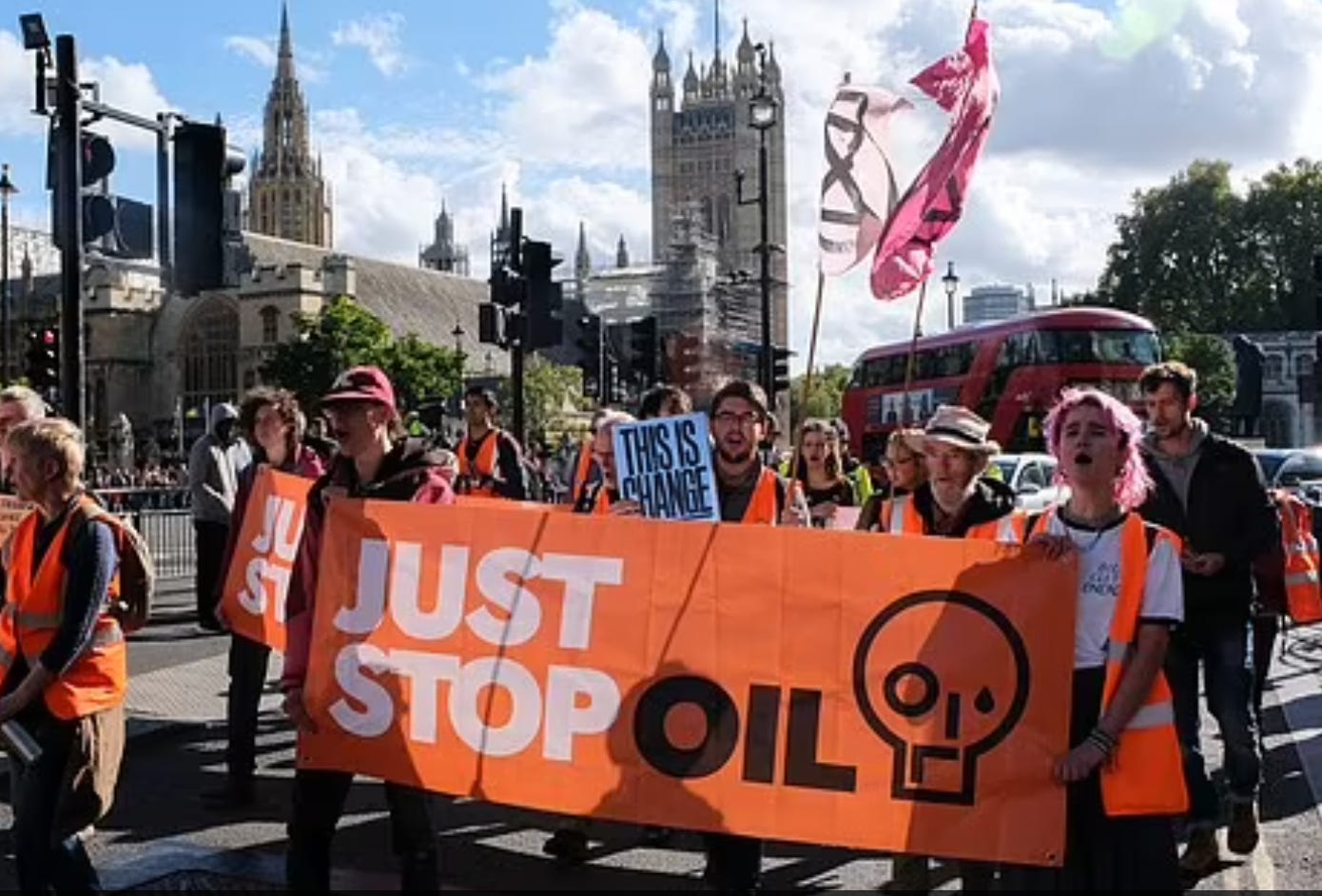
Nevertheless, impressive levels of social conflict have been activated by stirring up the race hatred pot, as well as any other pot within reach. I still don’t think they’ve yet achieved anything like the expected results, due to our aforementioned levels of tolerance and apathy - plus, the economy is still too good for most people to feel discomfort. There is a sense that since the victory of Donald Trump, who will return for a second term in the White House, a sense of panic has set in with the senile elites. And with world geopolitics as unstable now as they have been for generations, there is plenty of scope in the immediate future for things to get extremely strange. There’s never been a better time to stay aware of human programming flaws.
*****
Thanks for reading - if you enjoyed this then please consider buying me a coffee. These blog posts will always be free.
Wow. I studied the Cultural Revolution in college w Chinese prof (right after it happened), so look forward to this. Someone on X/Twitter posted a meme of a shot from a Red Guard loyalty rally as a comment on how the media in US are lionizing the young man who shot the healthcare exec.
And in real life, I met the wife of a childhood acquaintance who was a Chinese expat, former Red Guard. It was she who told me - not books or media - how many millions Mao killed.
A timely warning, absolutely. Becoming more aware of these processes has been one advantage of living through the Covid era for me. Now, don't get me wrong: I don't mean in any way to insinuate that people I disagree with are equivalent to the Red Guards. There's an ocean of difference between even the most rabid Covidian and those who consigned others to torture and death in 20th century China. Still, though, I feel like I got a sense of how these grotesque social processes can happen. Before it felt very alien, but now, between the pandemic and the rise of Wokery, it's like I've had a front-row seat to a very mild, very innocuous in relative terms, but still real example of the same pathology. Think of it as a vaccine, if you will. ;)
As for the modern West, you're probably right that apathy and wealth has something to do with the failure to stoke the same. At the same time, for all our culture's many, massive faults, I do think there's something genuine and valuable to our concepts of freedom of religion, conscience, assembly and speech as one of Western/Faustian/whatever you prefer to call it culture's important contributions to human culture as a whole. I really hope it can survive the end of industrial abundance, even if it doesn't look too promising at the moment.
Turns out that there's a lot of people who apparently never had much of a commitment to these principles in their own right, and have no problem with censorship as long as it's "their" side wielding it. Seeing many of the self-professed "pro-free speech" right turn on a dime to silence dissent against Israel is a very telling example here. This also applies to the "new" right, in that I can't help feel many of them don't genuinely have a problem with authoritarianism, they just want one that reflects their own values instead of the wokesters'. So where are those of us who detest authoritarianism in all its flavors meant to go?